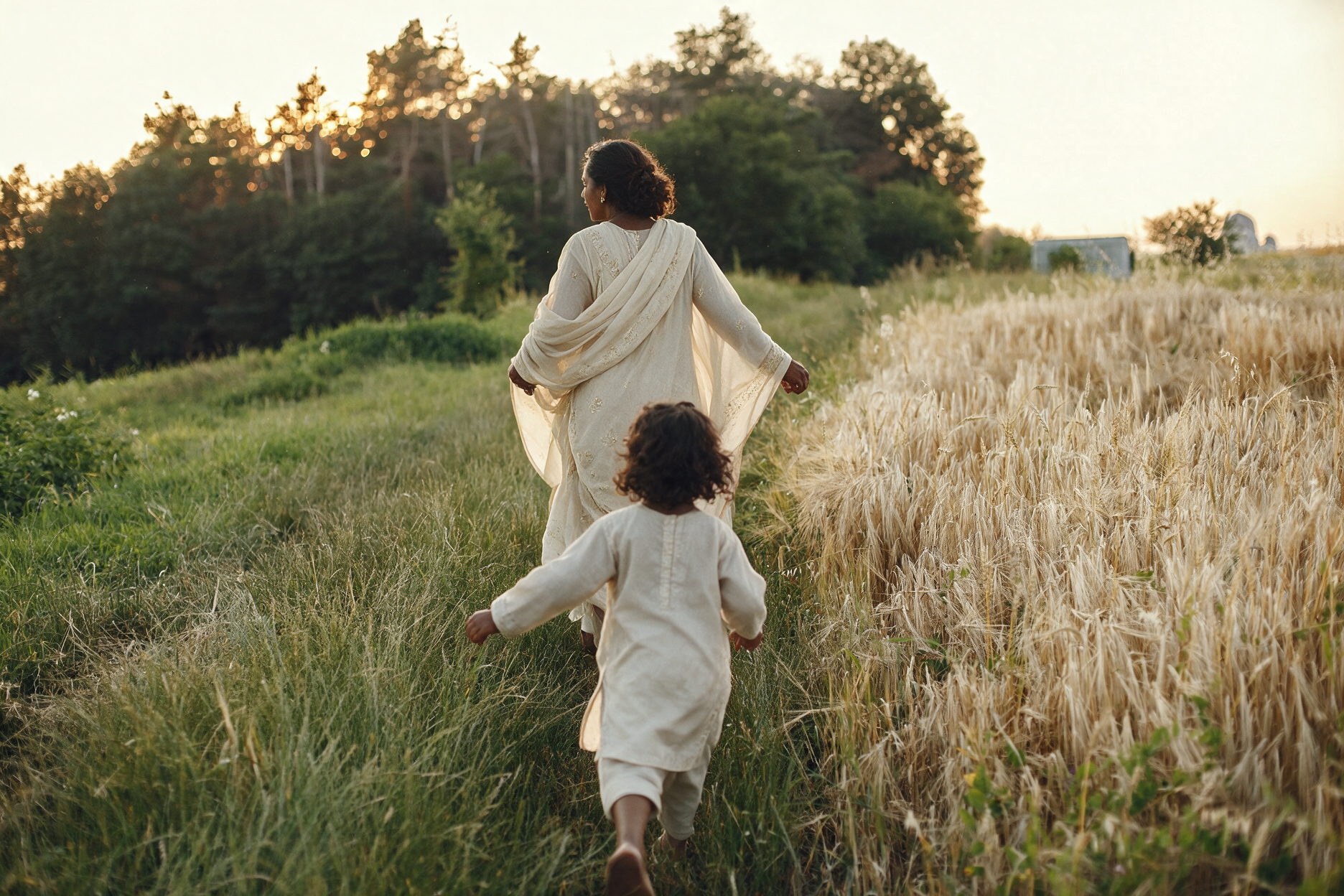
You ask, “Beta, khana kha liya?” They answer, “Yeah, I ate.”
They understood every word. They just didn’t give a single one back.
If this is happening in your house, you are in very good company. It isn’t a sign you’ve failed, or that your child “doesn’t like Urdu.” It’s one of the most studied patterns in bilingual families, and it’s very fixable, especially while kids are young.
What’s actually going on
Language runs on a loop: hear it, get comfortable, use it, hear more. Researchers call it the input–proficiency–use cycle. When kids use a language, people answer them in it, so they hear more of it. The loop feeds itself.
It also runs in reverse. When a child answers in English, the conversation usually continues in English. Less Urdu comes in, they get a little less comfortable, and next time English feels even easier.
And English has a big head start. School, friends, the pediatrician, the cashier at Target, every show on the iPad. Children tend to use the language they know better, and they get better fastest in the one they use most.
The study every parent teaching Urdu should know about
In 2007, researcher Annick De Houwer surveyed 1,899 bilingual families in Belgium. Every single child spoke the country’s main language. But not every child spoke the home language, even though all of them had heard it since birth.
The difference came down to who spoke what at home. Kids were most likely to speak the home language when both parents used it, and at most one parent used the majority language.
The surprise: “one parent, one language,” the strategy every bilingual parenting blog recommends, was neither necessary nor sufficient on its own.
In plain terms, it’s less about following a named method and more about how much Urdu is floating around your house, and from how many people.
The part nobody tells you
Children need a larger share of their input in the minority language to learn it as well as the majority one. A 50/50 split at home sounds fair, but it isn’t equal when school and the rest of the world are 100% English.
So if it feels like you’re doing “a lot” of Urdu and still getting English back, you’re not imagining it. The scales are tilted, and home is where you tilt them back.
What actually helps
1. Answer English with Urdu, not a correction. “Yeah, I ate.” → “Acha? Kya khaya? Daal chawal?” You stay in Urdu, and the conversation keeps going. Skip the “say it in Urdu” standoff. It turns the language into a test, and nobody likes tests at the dinner table.
2. Count your Urdu speakers, then add one. Nani on FaceTime. An aunty who babysits on Tuesdays. The other parent learning twenty words. A podcast voice in the car. Every new Urdu voice makes Urdu feel less like “Ami’s thing” and more like a real language people use.
3. Give Urdu one routine it owns. Bath time, breakfast, or the drive to school. Pick one slot where Urdu isn’t a rule, it’s just what happens. Consistency beats intensity. Ten minutes every day does more than one big Saturday push.
4. Create a real reason to use it. Kids use the language that works. A game where only Urdu answers score. A card deck where the answer has to be “billi,” not “cat.” A grandparent who lights up when they hear “Salaam, Nano!“
5. Give the less-fluent parent an easy way in. If your partner didn’t grow up with Urdu, flashcards are the lowest-pressure start. Hold up a card, ask “Yeh kya hai?“, and let your child be the teacher. Our Mere Pehley Urdu Alfaaz’ Flashcards were built for exactly this. A set of 40 flashcards, with one side of each card featuring a real photograph and the English word, the Urdu script, and Roman Urdu on the other.
One last thing
This isn’t a fluency test for you or your child. Every “Acha, kya khaya?” counts. Every time you answer in Urdu instead of switching, you’re feeding the loop in the right direction.
They’re still listening. Keep talking.
posted in:
comments